Decoding Ford Part Numbers
Decoding Content
I. Summary
II. Detailed Explanation
I. Summary
Casting and Part Numbers
Part numbers and casting numbers are pretty much the same when it comes to “hard parts”. Those are those big long codes (C7ZZ-6540544-DR, etc) that you find that identify every Ford part made. Many parts are too small to have the number cast or printed on it, but it still has a casting number. These numbers tell you what that part was originally designed for, what department designed it, and when it was designed. People are often confused by looking at a part or casting number. Just because a part was originally made for a Falcon doesn’t mean the part came off of a Falcon. Many Mustang parts were originally designed for the Falcon and carry a Falcon casting number. Ford is famous for using parts designed for one car on a variety of models.
A basic part number is included within the casting number and indicates what the part is, not what it was made for, or when it was made. An example could be a master cylinder – most master cylinders have a basic part number of 2140, but there a number of different master cylinders for different Ford vehicles. They all are master cylinders however, and share a basic part number.
Example for Illustrative Purposes
C5ZZ-2140-CR
C – Decade of Manufacture – 1960’s in this case
5 – Decade Year – This is a ’65
Z – Car line – Mustang
Z – Ford Service Part – This came from the Engineering Department
2140 – Basic part number – 2140 is a master cylinder
CR – Design Change – indicates manual disc brakes
Casting Code Definitions
Decade of Manufacture:
A = 1940
B = 1950
C = 1960
D = 1970
E = 1980
F = 1990
Decade Year:
The digit of the year. A C8 would be 1968, a D1 would be 1971, C3 is a 1963.
Car Line:
| Code | Car Line | Code | Car Line | |
|---|---|---|---|---|
| A | Galaxie | D | Falcon (60-69) | |
| F | Outside US, T/A Racing | G | Comet / Montego | |
| J | Industrial | M | Mercury | |
| O | Fairlane / Torino | P | Autolite / Motorcraft | |
| R | Rotunda | S | Thunderbird | |
| T | Truck | V | Lincoln (61+) | |
| Z | Mustang |
Engineering Department:
| Code | Component | Code | Component | |
|---|---|---|---|---|
| A | Chassis | B | Body | |
| E | Engine | F | Engine Accessories | |
| J | Automate (67-72) | P | Auto Transmission | |
| R | Manual Transmission | W | Axle | |
| X | Muscle Parts Program | Y | Lincoln/Mercury Service Parts | |
| Z | Ford Service Parts |
Basic Part Number:
This is the number that identifies what the part actually is – 2062 is a front slave cylinder, or 6268 is a timing chain set.
Design Change:
This indicates what application the basic part is used for. For example – “A” is for a 289/302 motor, whereas a “C” is for a 351C, 4v motor.
II. Detailed Explanation
Often friends will call me trying to determine Ford parts they can use or substitute. In SCCA Solo and Club Racing the rules often allow updating/backdating parts. In other words use a older or newer part from that product line of car. An example is my 1985 Mustang in American Sedan, generally I can use any bolt on component from 1979 through 1993 Capri or Mustang. The front brake system currently on the car is from a 1987 Mustang. The original 1985 brake system utilized an 10″ front rotor while the 1987 system is 11″ increasing the swept surface area of the brakes. The entire front suspension had to be replaced, lower front control arms, spindles, rotor, strut, calipers, brake hoses. Knowing how the part number system works helped considerably.
Ford part numbers are divided into two main categories Engineering and Service.
The engineers will design a part and assign it an Engineering part number, which is an alphanumeric reference code. When the part is redesigned the change needs to be noted so the Engineering part number is changed. When the part is released for Service it is assigned a Service part number. This allows Ford Parts and Service to track changes affecting interchangeability by modifying the Ford Service part number. The Service part number will not change with the Engineering part number unless the change affects interchangeability. Due to this the part numbers on the part are generally Engineering numbers while the Service part number will be on the box. There are some exceptions, such as a whole grouping of parts or a kit. Engineering and Service numbers decode the same way. The difference being the fourth character of the prefix. Part numbers consist of a prefix, a basic part number, and a suffix.
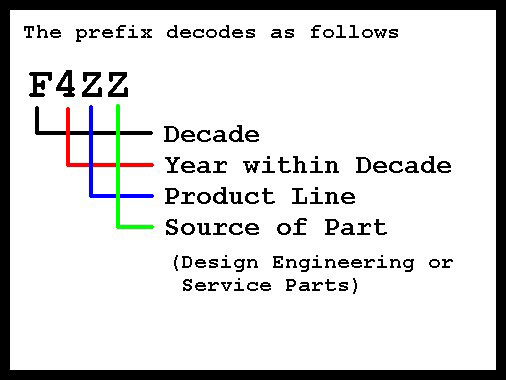
An example would be F4ZZ (prefix), 6E086 (basic part number), -A (suffix). The first character of the prefix indicates the decade of design, starting with “A” for the 1940’s, B for the 1950’s, C for the 1960’s. The second character of the indicates the year within the decade, “C5” would be 1965, “F4” would be 1994. The third character of the prefix indicates the product part the part was originally designed for, with few exceptions. Note that “outside sales (code F), “Motorcraft Brand” (code P), or imported parts from Ford of Europe (code R) are identified with their product line code in the third position. The fourth character indicates the part source, whether it is product engineering office or service part. The part number F4ZZ-6E086-A would equate to F4 = 1994, the third character Z = Mustang, the fourth character Z = Ford Parts and Services. The next group of numbers describe the part. I use these numbers at swap meets or salvage yard to match to existing numbers I have. I know if the basic number is the same it should be compatible if the suffix number on the part you are comparing is a later alpha character than the existing one. Early suffix designations generally begin with “A” and increment through the alphabet as design changes are made that affect interchangeability. If the suffix on the part I was looking to replace (my existing part) was an “A” I could use parts with have a “B” suffix. If the part I was looking to replace (my existing part) had a “B” suffix, a part with the “A” suffix would probably have a compatibility issue. Parts that have later suffix codes are the ones to get.
Prefix Decoding
Product Line Codes
| Third Digit | Product Line (Use the third character of the part number with this chart.) |
|---|---|
| A | Ford, 1958-later |
| B | Bronco, 1970-73; Maverick 1975-77; Fairmont 1978-83 |
| C | Remanufactured parts 1966-75 |
| D | Falcon 1960-69; Maverick 1970-74; Granada 1975-82; LTD 1983-later |
| E | Truck (cab over engine) 1970-73; Pinto1976-80; Escort 1981-later |
| F | Outside sales1962-later |
| G | Comet 1961-67; Montego1968-76; EXP 1982-later |
| H | Heavy truck 1966-82; Medium and heavy truck 1983-later |
| I | Not Used |
| J | Industrial Engines |
| K | Edsel 1958-60; Cab trucks 1970-73; Comet 1975-77; Zephyr 1978-83; Marquis 1983-later |
| L | Lincoln 1958-60; Mark 1961-later |
| M | Mercury 1958-later |
| N | Tractor 1958-later |
| O | Fairlane 1962-68; Torino 1969-76; LTD II 1977-79; LN7 1982-83 |
| P | Motorcraft (or Autolite) 1962-later |
| Q | Not Used |
| R | Rotunda Brand1962-69; vehicles imported from Ford of Europe1970-later |
| S | Thunderbird 1958-later |
| T | All truck 1958-65; light and medium truck including Bronco 1974-82; light truck and Bronco I 1983-later |
| U | Econoline 1961-later |
| V | Lincoln Continental 1961-81; |
| W | Cougar 1966-72; Bobcat 1975-80; Lynx 1981-later |
| X | Trucks (short highway) 1970-73 |
| Y | Meteor (Canadian) 1962-73; Bobcat 1975-80; Lynx 1981-later |
| Z | Mustang 1964-73; Mustang II 1974-78; Mustang 1979-later |
| 1 | Not Used |
| 2 | Pinto 1971-75 |
| 3 | Tempo 1984-later |
| 4 | Comet 1971-74; Monarch 1975-80; Cougar 1981-82; Marquis 1983-later |
| 5 | Recreational vehicles 1974-75; Continental 1982-later |
| 6 | Pantera 1971-75; Ranger and Bronco II 1983-later |
| 7 | Courier truck 1971-75; Ranger and Bronco II 1983-later |
| 8 | Capri (US designed parts) 1972-75 |
| 9 | Turbine engine parts 1970-75 |
Source Codes
| Fourth digit | Source Codes (Use the fourth character of the part number with this chart.) |
|---|---|
| A | Light truck Engineering |
| B | Body and electrical product Engineering |
| C | Chassis Engineering ; Powertrain and Chassis product Engineering |
| D | Overseas product Engineering |
| E | Engine Engineering; Powertrain and Chassis product Engineering |
| F | Electrical and Electronics Division; Product Engineering office |
| G | Not Used |
| H | Climate Control Division; Product Engineering office |
| I | Not Used |
| J | Ford Parts and Service Division; Parts and Service Engineering office |
| K | Not Used |
| L | Ford Parts and Service Division; Industrial Engine Operations |
| M | Performance Operations; SVO Service Parts |
| N | Ford Tractor Operations; Product Engineering Office; Diversified Products Operations |
| O | Not Used |
| P | Transmission and Axle Engineering; Powertrain and Chassis Product Engineering (Automatic Transmissions) |
| Q | Not Used |
| R | Transmission and Axle Engineering; Powertrain and Chassis Product Engineering (Manual Transmissions) |
| S | Light and Heavy Truck Engineering; Truck Special Ordering Department |
| T | Heavy Truck Engineering |
| U | Special Vehicles Operations |
| V | Vehicle Special Ordering and Engineering Section |
| W | Transmission and Axle Engineering; Powertrain and Chassis Product Engineering (axle) |
| X | Emissions, Economy and Special Vehicle Engineering |
| Y | Ford Parts and Service Division; Parts Engineering Office (Lincoln Mercury Division Service Parts) |
| Z | Ford Parts and Service Division; Parts Engineering Office (Ford Division Service Parts) |
Decoding Dates
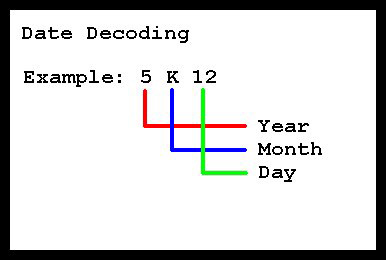
Date codes are sometimes included on parts. The first digit is the year. To determine the decade, refer to the part number’s prefix. The second digit is the month. Note that the character “I” is not used. Refer to the chart below. The third digit is the day of the month.
| Second Digit | Month |
|---|---|
| A | January |
| B | February |
| C | March |
| D | April |
| E | May |
| F | June |
| G | July |
| H | August |
| I | Not Used |
| J | September |
| K | October |
| L | November |
| M | December |